Responding to a Summer of Change
This summer posed huge challenges for educational institutions. As much of education moved online, we were all asking: how do we maintain social relationships, conversation, and access to learning? For ArtLab, it meant we could no longer run our usual summer workshops—sessions we’ve delivered for the past five years with Year 5 and 6 pupils across the Reading area during the final weeks of the summer term. These workshops had always been spaces for making, sharing stories, and learning from one another.

Rethinking Resources and Routines
With in-person workshops off the table, we turned our focus to the resources we had at home—and their creative potential. At the same time, we were acutely aware of the immense pressures on teachers, pupils, and families: continuing education, managing mental wellbeing, and establishing new routines. This context led to the birth of Lockdown Lab—a collection of simple, accessible resources that celebrated creativity using what’s already around us. The focus was on low-cost, low-waste, and rethinking everyday environments through imagination.
“We began turning to the things we have in our homes and their creative possibilities…”
A Shared Movement of Making
Lockdown Lab emerged as part of a wider movement. Across the world, people began sharing open-source activities, videos, and creative prompts. New communities formed, often online, as individuals and organisations found ways to support and uplift one another. However, the inequalities around digital access were impossible to ignore. Lockdown highlighted huge disparities in access to technology, and exposed long-standing issues that many had experienced for years.
“Access became an everyday conversation… recognising the everyday privilege, much taken for granted, in being able to leave your home safely.”
Learning from the Process
As we developed video resources, we became more intentional in our choices—thinking carefully about language, voice, and how ideas are communicated visually and audibly. Often, this meant asking ourselves: Do I really need this? Are there other ways around it? Through this process, we developed new skills and became more aware of things we’d previously taken for granted.
Conversations with our student co-researchers brought a strong sense of grounding, as we started reflecting on core needs—echoing Maslow’s Hierarchy of Needs. This focus on the basics was not only practical but heart-warming.
Nature, Movement, and Everyday Objects
Nature played a powerful role in our work. It appeared in Tehya’s animation Even in Tarmac Flowers Grow, and in Khadija’s response to the Camden Arts exhibition Camden Botanic Print, where observation, colour, and respect for the natural world were central. Cerys’ animation The Importance of Bees celebrated movement and connection with nature, while the Move Your Bodies video series brought participants outdoors to explore sensation, breath, and movement through mindful exercises.
Everyday materials also became a source of inspiration. Paper and cardboard were transformed in countless ways—from origami sculptures like Fajar’s Origami Heart and Antonia’s Origami Eye, to the Cereal Box Challenge and Kidtronics step-by-step makes. These works demonstrated how simple objects can become tools for storytelling, play, and discovery.


Transformation and Identity
Transformation was a recurring theme. Or’s Animate Your Self explored how toys and trinkets can reflect personal identity. Cerys’ Hand Animals used the barest materials to create something beautifully unpredictable through shadow play. Jessica’s playful Ikea Fort reviewed online hacks for turning household items into imaginative dens—a joyful nod to both childhood and adult creativity.
Charlotte’s Make a Connection piece used her garden as a canvas, mapping relationships between animals with bricks, paper plates, and wool—an intuitive exploration of connection and knowledge-making.
“Laying things out can help us think through ideas and strands of thought.”
Hope, Reflection, and Collective Action
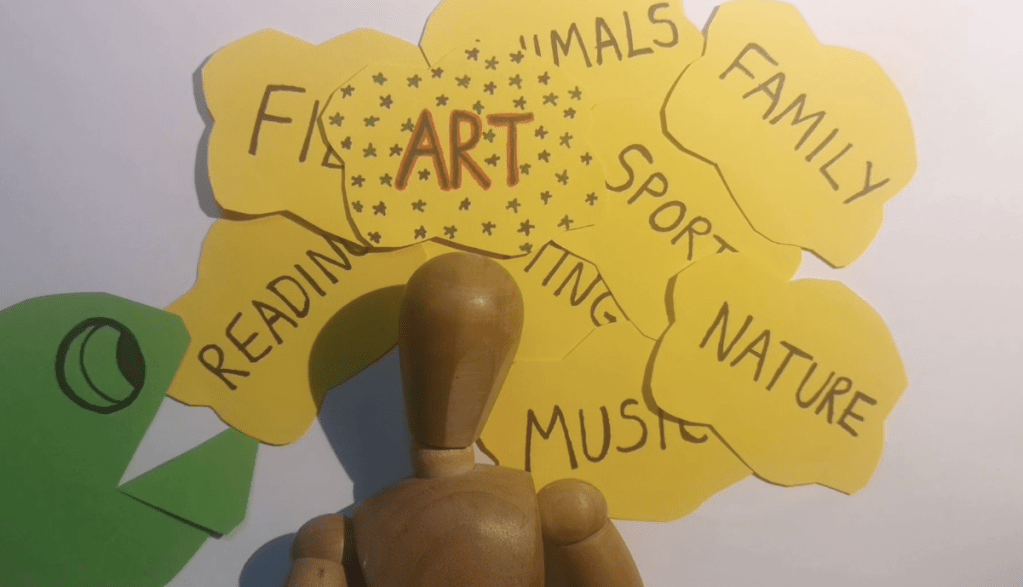
Jennifer’s animation What Inspires You? and its companion video What Inspires Me? offered a personal insight into lockdown motivation and the grounding role of art. Lennox’s review of the Tate’s How to Make a Protest Poster posed a powerful question: What do you care about? Their poster read:
“We can make a change together.”
—a message of hope and a call for collective care and action.
Looking Ahead
Our hope is that Lockdown Lab offered moments of escapism, opportunities for creative reflection, and new ways to explore the everyday. For ArtLab, it remains a valuable resource—one we’ll continue to learn from and build upon in future activities.
We’re incredibly grateful to all our student co-researchers for their creativity, energy, and generosity in contributing to this evolving space.
 ArtLab
Leave a comment